Podium Pavement Works · North Houston TX
ADA & Handicap Parking Lot Striping in North Houston TX
TAS-compliant handicap parking stall markings across North Houston, ISA stenciling, van-accessible designations, and stall counts verified against Texas Accessibility Standards. TDLR-compliant work on every job.
What Is Handicap Parking Striping?
Handicap parking striping covers the marked stall itself: the painted borders that define its boundaries, the International Symbol of Accessibility (ISA) stencil on the pavement, and any van-accessible designation text. These are the markings that make an accessible stall visible to drivers and identifiable during a TDLR inspection.
In Texas, the required number of accessible stalls scales with your total lot size, TAS sets a required count for every range of total stalls. At least one stall per group must be van-accessible. A standard accessible stall is 8 feet wide; a van-accessible stall is 11 feet wide (or 8 feet wide with a dedicated 8-foot access aisle). We verify the required count and configuration for your specific lot before quoting and flag any shortfall in writing.
Who Needs This Service
- Any Commercial Property Open to the Public, ADA accessible stalls are required by law; the required count scales with total lot size per TAS
- Medical Offices & Healthcare Facilities, outpatient facilities have higher required ratios; TDLR inspects these closely and accessible parking is one of the first things they check
- Retail Centers & Strip Malls, ADA compliance failures on commercial retail result in TDLR complaints and can affect certificate of occupancy
- Apartment Complexes, multifamily properties are subject to accessible parking requirements under TAS and Fair Housing Act provisions
- Office Parks & Employers, employer parking areas must include accessible stalls; they must be on the accessible route to the building entrance
- Schools & Government Properties, accessible parking is required for all public-facing government and education facilities
ADA vs TAS: What Texas Property Owners Need to Know
Federal ADA sets the baseline. Texas adds its own layer on top. That layer is called TAS, the Texas Accessibility Standards. Property owners in Texas have to meet both. In practice, TAS is what gets inspected on commercial lots in our area.
TAS is enforced by TDLR, the Texas Department of Licensing and Regulation. If your lot has more than a small number of spaces or you are doing new construction or a remodel above a cost threshold, your project gets a Registered Accessibility Specialist review. That review checks accessible parking count, stall dimensions, access aisle width, signage, slope, and surface markings.
Where federal ADA and TAS differ, TAS is usually stricter. Stall counts are the same. Access aisle widths are the same. Signage requirements line up. But TAS spells out what the markings have to look like in more detail, and Texas inspectors actually enforce it.
Bottom line for a property owner: if your stalls meet TAS, you meet ADA too. If they only meet federal ADA, you might still fail a Texas inspection. We stripe to TAS spec on every job.
Our Process
- 01
Stall Count & Assessment
We count your total stalls and existing accessible stalls, check current marking condition, and identify any stalls that are missing or misconfigured. You get a written quote with a note on whether the current count meets TAS requirements.
- 02
TAS Compliance Review
We confirm the correct number of accessible stalls for your lot size, verify van-accessible placement, and check stall widths. If your current count is short, we quote the additions separately so you can make an informed decision before we start.
- 03
Marking Application
We paint stall borders, ISA stencils, and any van-accessible text. All work is done to TAS dimension requirements using commercial-grade latex.
- 04
Documentation
We photograph each accessible stall and provide a photo record of the stall count and configuration for TDLR compliance documentation and property manager files.
Why Property Managers Choose Podium
- 01
Written Quotes
We’ll walk your lot and give you a written estimate, no fee, no obligation, in our core North Houston service area. If it’s worth your time to call, it’s worth our time to come out.
- 02
Insured Crew, Real Schedules
We carry general liability insurance and run early-morning, after-hours, and weekend jobs to keep your lot open during business hours.
- 03
Code-Compliant Markings
Fire lanes, ADA accessible stalls, ISA stencils, and access-aisle hash-lines done to local fire-code and Texas Accessibility Standards, not generic guesses.
- 04
Honest, Itemized Bids
Our quotes break out code-required work from cosmetic work in writing, so you know exactly what you’re paying for before we start.
- 05
Stall Count Verified Before Every Quote
We verify the required number of accessible stalls for your lot size against the TAS table before quoting. If your current count is deficient, we tell you up front and quote the additions separately so you know the compliance obligation before we start.
Handicap Parking Requirements Under TAS
Texas adds its own rules, called the Texas Accessibility Standards (TAS), on top of the federal ADA rules. A state agency called TDLR runs the TAS program. For most parking rules, TAS matches the 2010 federal ADA standards, but Texas enforces them on its own. TDLR reviews the plans for new buildings and big remodels, and it takes accessibility complaints about existing properties.
The required number of accessible stalls scales with your total stall count. At least one stall in each group of accessible stalls must be van-accessible. Van-accessible stalls require either an 11-foot-wide stall (with an 8-foot shared aisle) or an 8-foot-wide stall with a dedicated 8-foot access aisle.
TAS Required Accessible Stall Counts
- 1-25 total spaces: 1 accessible stall (1 van-accessible)
- 26-50 total spaces: 2 accessible stalls (1 van-accessible)
- 51-75 total spaces: 3 accessible stalls (1 van-accessible)
- 76-100 total spaces: 4 accessible stalls (1 van-accessible)
- 101-150 total spaces: 5 accessible stalls (1 van-accessible)
- 151-200 total spaces: 6 accessible stalls (1 van-accessible)
- 201-300 total spaces: 7 accessible stalls (2 van-accessible)
- 301-400 total spaces: 8 accessible stalls (2 van-accessible)
- 401-500 total spaces: 9 accessible stalls (3 van-accessible)
- 501-1000 total spaces: 2% of total (1 van-accessible per 6 accessible, minimum 1)
- 1001+ total spaces: 20 + 1 per 100 over 1000 (1 van-accessible per 6 accessible)
Van-Accessible & Stall Dimensions
- Standard accessible stall width: 96 inches (8 feet) minimum.
- Van-accessible option 1: 132-inch (11-foot) stall with an 8-foot access aisle shared on the adjacent side.
- Van-accessible option 2: 96-inch (8-foot) stall with a dedicated 96-inch (8-foot) access aisle, must be marked “Van Accessible.”
- ISA stencil: International Symbol of Accessibility painted on the stall pavement at each accessible stall, centered in the stall and sized to be visible from the drive aisle.
- Signage: Each accessible stall requires a TAS-compliant sign with the ISA symbol at the required height. Sign installation is outside our scope, we handle pavement markings only.
- Slope: Maximum 2% (1:50) in all directions within the stall and access aisle. Structural slope issues are not correctable with paint; we flag them during the site walk.
- Location and route: accessible stalls must sit on the shortest accessible route to an accessible building entrance. If your lot has more than one accessible entrance, the accessible stalls are spread out so each entrance has nearby accessible parking.
- Covered parking clearance: if parking is covered, like a garage or carport, the van-accessible spaces, their access aisles, and the route a van takes to reach them need at least 98 inches of overhead clearance.
- Passenger loading zones: where a property has a drop-off or loading zone, it needs an access aisle at least 60 inches wide and 20 feet long next to the pull-up space.
Access Aisle Requirements
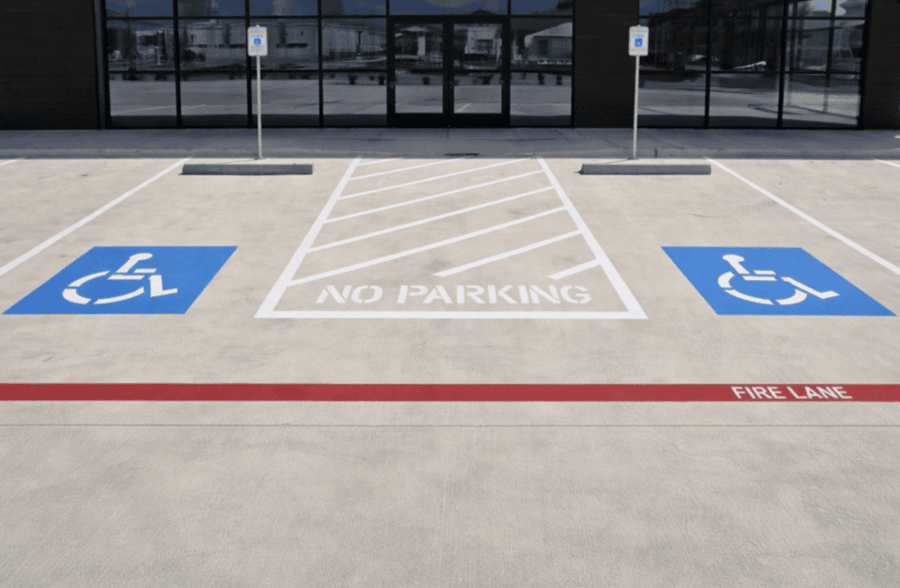
The access aisle is the striped area next to a handicap stall. It is where a wheelchair user or someone with a mobility aid actually transfers in and out of the vehicle. Without a compliant access aisle, the stall fails inspection no matter how good the rest of it looks.
Two widths matter. A standard accessible stall needs a 5-foot access aisle. A van-accessible stall needs an 8-foot access aisle, unless you use the alternative configuration (8-foot stall plus 8-foot aisle). The aisle runs the full length of the parking space.
The aisle gets hash-line striping inside it. Diagonal lines, spaced consistently, marked to discourage parking. TAS does not specify the color or angle of the hash lines, so we follow common Texas practice and use white or blue at 45 degrees unless a local jurisdiction calls for something different. Some lots add a NO PARKING stencil inside the aisle as extra reinforcement. We do this on request when site lines or visibility are an issue.
Two stalls can share one access aisle. If you have a standard and a van-accessible stall side by side, the access aisle between them needs to meet the wider of the two stalls’ requirements. The aisle gets marked once, and both stalls use it.
The aisle has to be nearly level. TAS allows a maximum slope of 1:48 in any direction (about 2 percent), which is enough for drainage but not enough to cause a wheelchair to roll. If your aisle has more slope than that, restriping alone will not fix it. The surface itself has to be regraded.
Faded or missing hash lines are one of the most common compliance issues we see on older lots. The stalls themselves look fine, but the aisle has worn down to bare asphalt. That fails inspection.
What Non-Compliance Costs You
If your accessible parking is missing, faded, or does not meet Texas standards, it can cost you in a few ways:
Five Ways It Costs You
- TDLR complaints. Texas takes accessibility complaints on existing properties through the TDLR complaint program. A single complaint can put your lot under review.
- Plan-review hold-ups. New construction and larger remodels get reviewed by a Registered Accessibility Specialist. Wrong or missing accessible parking can stall the project.
- Certificate of occupancy risk. On a new build or remodel, accessible-parking problems can hold up your certificate of occupancy or permits.
- Private lawsuits. Texas sees a lot of ADA parking lawsuits. A non-compliant lot is an easy target, and settling or defending one costs far more than fixing the striping.
- Federal penalties. Federal ADA law also allows civil penalties for violations, with higher amounts for repeat problems.
The good news is this is easy to prevent. We stripe to TAS spec and give you a photo record of every accessible stall, so your lot holds up to an inspection or a complaint.
Common ADA Problems We Fix
If your lot already has accessible-parking issues, we can usually bring it up to standard in one visit.
- 01
Faded ISA Symbols
The wheelchair symbol painted in the stall wears down over time. We repaint it to the right size and placement.
- 02
Missing Van-Accessible Markings
Van stalls need the wider aisle and the “Van Accessible” marking. We add what is missing.
- 03
Narrow or Unmarked Access Aisles
We restripe access aisles to the correct width with proper hash lines.
- 04
Too Few Accessible Stalls
If your count is short for your lot size, we lay out and stripe the added stalls.
If a problem is structural, like a slope that is too steep, paint cannot fix it. We flag that during the site walk so you know before any work starts.
Recent Projects

Serving North Houston & the Region
We cover eight Texas counties: Montgomery, Harris, Fort Bend, Walker, Waller, Liberty, Brazos. Jobs run throughout the region, from The Woodlands south to Houston, from Katy east to Kingwood and Cleveland.
What Does This Service Cost?
Price depends on your lot’s specific conditions. Below are the main factors that affect the quote. We don’t publish flat rates because every job is different, a written estimate is the only way to get an accurate number. For the wider picture, here is what parking lot striping costs in Texas.
- Required Stall CountThe number of accessible stalls required by TAS scales with your lot size. We verify the required count during the site walk and quote the exact number needed.
- Van-Accessible ConfigurationVan-accessible stalls require either an 11-foot stall or an 8-foot stall with a dedicated 8-foot access aisle. The configuration affects adjacent stall layout and may require repositioning.
- Scope, New vs. RefreshAdding new accessible stalls to a lot costs more than refreshing markings on existing compliant stalls. We break this out in the written quote so you can see what is code-required versus cosmetic.
- Stall ConditionStalls with heavily faded ISA stencils or deteriorated borders may need a heavier paint application. We note this during the estimate.
Frequently Asked Questions
How many handicap spaces does my parking lot need in Texas?
The count is based on total parking spaces. The first 25 spaces require 1 accessible stall. From 26 to 50 total, you need 2. From 51 to 75, you need 3. From 76 to 100, you need 4. The table keeps climbing from there, with larger lots calculated at 2 percent of total once you pass 500. For every 6 accessible stalls (or fraction of 6), at least 1 has to be van-accessible. So 7 accessible stalls means 2 of them are van-accessible. Special rules apply to medical facilities and rehab clinics. We can tell you the required count from a quick site visit or a satellite photo.
What is the difference between a standard accessible stall and a van-accessible stall?
A standard accessible stall is 8 feet wide minimum, with a 5-foot access aisle next to it. A van-accessible stall is 11 feet wide minimum, with the same 5-foot access aisle. TAS allows an alternative: an 8-foot van stall paired with an 8-foot access aisle. Either configuration is compliant. The “VAN ACCESSIBLE” sign or stencil tells drivers which stalls are sized for vans with side-loading lifts.
What markings are required at a handicap parking stall?
A compliant stall has four things. First, the stall outline striped to define the width. Second, an ISA symbol painted in the center of the stall. Third, the access aisle next to the stall striped with hash lines to discourage parking in it. Fourth, a pole-mounted sign with the ISA and the “Reserved” designation. TAS requires the sign to be at least 60 inches above the ground, measured to the bottom of the sign. Van-accessible stalls add the “VAN ACCESSIBLE” designation, either as a stencil or a second sign panel. TAS does not specify marking colors. Local convention in Texas is white or blue.
What is TAS and how does it apply to accessible parking in Texas?
TAS is the Texas Accessibility Standards. It is the Texas version of federal ADA rules, enforced by TDLR. For commercial lots, TAS is the standard that gets inspected. It mostly mirrors federal ADA but is more specific in places, especially about how markings have to look. If your lot meets TAS, it meets ADA. The reverse is not always true.
How wide does an ADA access aisle need to be in Texas?
Five feet for a standard accessible stall. Eight feet for a van-accessible stall. The aisle runs the full length of the parking space. If two accessible stalls share one access aisle, the aisle has to meet the wider of the two requirements.
Can faded handicap or access aisle markings result in a compliance violation?
Yes. TAS requires markings to be visible. If the stall outline, the ISA symbol, or the access aisle hash lines have faded to the point an inspector cannot clearly see them, the stall fails. This is one of the most common issues we get called out for. A restripe usually solves it in a day.
What is the difference between ADA and TAS, and which one applies to my lot?
ADA is the federal Americans with Disabilities Act. TAS is the Texas Accessibility Standards. Both apply to commercial property in Texas, but TAS is the one enforced by TDLR inspectors. Where the two differ, TAS is usually stricter. Striping to TAS spec covers both.
How long does an ADA stall marking job take?
A typical 2 or 3 stall ADA touch-up is a half-day job. A full lot restripe with ADA work included is usually one day for a smaller commercial lot, two days for a larger one. Paint cure time is 30 minutes to traffic, longer in cold or wet conditions. We schedule around your business hours when possible.
What are the penalties for non-compliant ADA parking in Texas?
It depends on the situation. On an existing lot, a complaint can go to TDLR for review. New builds and big remodels get a plan review that can stall your certificate of occupancy. Texas also sees a lot of private ADA lawsuits over parking. Federal ADA law allows civil penalties as well. In every case, fixing the striping is far cheaper than the alternatives.
Where do accessible parking spaces have to be located?
On the shortest accessible route to an accessible building entrance. If your lot has more than one accessible entrance, the accessible stalls are spread out so each entrance has nearby accessible parking.
Ready to Get Your Lot Striped?
Call us or send a message. No travel fees in our core service area. Insured. Written Quotes.
Request a Written Quote Call (281) 826-2527 (281) 826-2527Curious what ADA stall striping costs on your lot? Our cost estimator gives you a quick range.